

If you have searched for fintechasia .net telekom, you may have noticed that the phrase can be confusing. It looks like the name of a company, service, or technology platform, but there is an important distinction to make before going any further.
FintechAsia.net is a digital publication covering fintech and related technology topics. Its current content includes coverage of telecommunications, payments, mobile wallets, digital credit, APIs, and partnerships between telecom companies and financial-service businesses. The phrase fintechasia .net telekom appears in this context rather than establishing a separate telecom operator or financial product.
What Is FintechAsia.net?
FintechAsia.net is a website that publishes content related to financial technology and associated areas of the digital economy. Its recent categories include finance, technology, crypto, trading, and other fintech-related subjects. Its own recent articles describe the site as a source of Asian fintech news, guides, and industry information.
For someone researching fintechasia .net telekom, the most relevant material is its coverage of the relationship between telecom companies and financial services. A June 2026 article, for example, discusses telecom partnerships involving carrier billing, mobile wallets, APIs, payments, and digital credit.
The Connection Between Fintech and Telecommunications
Fintech and telecommunications are closely connected because many modern financial services depend on digital connectivity. A customer using mobile banking, a digital wallet, an online payment service, or another connected financial application needs a communications network to exchange information with the service provider.
Mobile networks and internet infrastructure therefore form an important part of the environment in which digital finance operates.
The World Bank describes digital financial services as financial services delivered through digital technologies, including mobile devices and the internet. These services can include payments, electronic money, digital wallets, credit, savings, insurance, and investments.
Why This Topic Matters in the Digital Economy
The connection matters because financial activity is becoming increasingly digital and mobile.
The IMF has identified mobile money, mobile banking, and internet banking as important parts of the continuing transformation of financial access. The organization’s Financial Access Survey has also documented substantial growth in digital financial transactions, particularly across emerging and developing economies.
This creates opportunities for financial institutions, fintech companies, telecommunications operators, merchants, and consumers. At the same time, fintechasia .net telekom introduces questions around cybersecurity, privacy, regulation, interoperability, and consumer protection.
What Does Telekom Mean in Fintech?
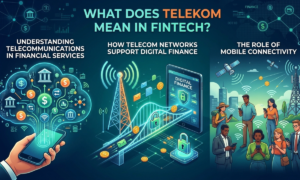
Understanding Telecommunications in Financial Services
“Telekom” is commonly used as a shortened reference to telecommunications. In a fintech discussion, fintechasia .net telekom can describe the telecommunications networks, companies, infrastructure, and services that help connect users with digital financial products.
Telecom companies can have extensive customer relationships and distribution networks. Depending on the market and regulatory framework, they may partner with banks, payment companies, or fintech businesses to support services such as mobile payments and digital wallets.
How Telecom Networks Support Digital Finance
Telecommunications networks provide the connectivity needed by many mobile financial services.
For example, when a user opens a financial application, authenticates an account, sends a payment request, or receives a transaction notification, information must travel between the user’s device and the relevant service infrastructure.
The Role of Mobile Connectivity
Mobile connectivity has helped make financial services accessible through devices that many people already use every day.
Mobile money is a good example. The World Bank describes mobile money as electronic money in which funds are represented digitally and transactions can be initiated through a mobile phone.
This model can be particularly relevant in markets where mobile-phone access is more widespread than traditional banking infrastructure.
FintechAsia .net Telekom Explained
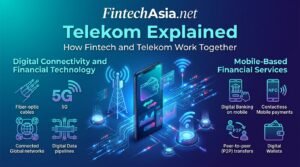
How Fintech and Telekom Work Together
The relationship between fintech and telecom can involve several different business models.
A telecom operator may provide network connectivity while a bank or fintech company supplies the financial product. In another model, the telecom company may partner with a payment provider or operate a regulated financial service. Carrier billing, mobile wallets, payment APIs, and other forms of digital integration can connect the two industries.
Digital Connectivity and Financial Technology
Digital connectivity is one of the foundations of modern fintech. A digital financial service may involve several layers: a customer’s device, a telecommunications or internet connection, an application or website, authentication systems, payment infrastructure, and the financial institution or fintech company responsible for the service.
The World Bank’s digital-finance resources emphasize the importance of digital infrastructure and connectivity in the development of digital financial services.
Mobile-Based Financial Services
Mobile financial services cover a broad range of activities.
Depending on the market, users may be able to make payments, transfer money, receive funds, pay bills, access mobile banking, or use digital wallets through mobile devices.
The IMF distinguishes mobile money from mobile banking. Mobile money can operate through a mobile-based account or electronic-money system, while mobile banking generally provides access to an existing bank account through a mobile device.
The distinction matters because not every mobile financial service is the same, even though all may depend on mobile connectivity.
Key Technologies Behind Fintech and Telekom
Mobile Networks and Digital Payments
Mobile networks allow connected devices to communicate with online financial services. This connectivity can support digital payments, account access, notifications, authentication, and other activities.
Digital payment systems themselves involve much more than a mobile network. Banks, payment processors, merchants, payment schemes, regulators, and technology providers can all play different roles.
The World Bank identifies digital payment platforms, electronic money, and digital wallets as important components of digital financial services.
Cloud Computing
Cloud computing can provide computing, storage, and other technology resources used by modern digital services.
For fintech companies, cloud infrastructure can help support applications and systems that need to process changing workloads. However, cloud adoption also requires appropriate security, resilience, data-management, and regulatory controls.
The important point is that cloud computing is an enabling technology rather than a financial product itself.
Artificial Intelligence
Artificial intelligence is becoming increasingly relevant to financial services.
Potential applications include customer support, fraud detection, risk analysis, document processing, and other operational tasks. BIS research has examined the growing use of AI in banking and the related implications for risk management and financial stability.
AI also creates new risks, including concerns around data quality, model errors, cybersecurity, fraud, and explainability.
Data Security and Digital Identity
Security becomes especially important when telecommunications and financial services are connected.
Digital financial systems may handle personal information, account information, transaction records, and authentication data. Protecting this information requires technical controls as well as appropriate policies and regulations.
Digital identity can help service providers establish that a person is who they claim to be, but identity systems differ between countries and organizations.
Benefits of Fintech and Telekom Integration
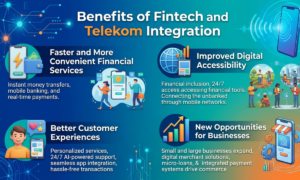
Faster and More Convenient Financial Services
Digital services can reduce the need for customers to visit a physical location for certain transactions.
Depending on the service, users can make payments, transfer money, check information, or manage accounts through connected devices.
The convenience comes from digital access rather than from telecommunications alone.
Improved Digital Accessibility
Telecommunications can help extend digital services into areas where physical financial infrastructure may be limited.
Mobile financial services are particularly relevant to financial inclusion because they can provide an additional access channel for people who may have limited access to traditional financial institutions. ITU identifies mobile financial services as an important part of the broader digital and financial-inclusion landscape.
Better Customer Experiences
When financial services are designed well, mobile connectivity can make them easier to access. Customers may receive transaction notifications, use mobile applications, make digital payments, or manage services without depending entirely on physical branches.
The quality of the experience still depends on network reliability, application design, pricing, security, and customer support.
New Opportunities for Businesses
The connection between telecom and fintech can also create opportunities for businesses. FintechAsia.net’s coverage discusses partnerships, carrier billing, APIs, mobile wallets, and telecom distribution networks as examples of how the two industries can work together.
For merchants and service providers, digital payment channels can provide additional ways to accept transactions and reach customers.
FintechAsia .net Telekom and Digital Payment Trends
Mobile Wallets and Contactless Payments
Mobile wallets have become an important part of the digital-payment ecosystem.
A wallet may allow users to store payment information or electronic value and use a mobile device to make transactions. Some wallet systems are connected to bank accounts, while others can operate through electronic-money arrangements.
Contactless payments are another part of the wider digital-payment landscape. Their availability depends on the specific technology, payment infrastructure, device, merchant system, and local market.
Real-Time Digital Transactions
Digital payment systems can allow financial transactions to be initiated and processed electronically.
However, fintechasia .net telekom is important not to assume that every digital payment settles instantly. “Real-time” can refer to different stages of transaction processing, while final settlement depends on the payment infrastructure involved.
The World Bank emphasizes the importance of safe, efficient, and reliable payment systems for the digital economy.
The Growth of Mobile Financial Services
Mobile financial services have expanded alongside mobile connectivity. The IMF’s Financial Access Survey tracks developments in mobile money, mobile banking, and internet banking and shows how digital channels have become increasingly important to financial access.
This growth helps explain why telecommunications companies increasingly appear in fintech discussions.
Challenges in the Fintech and Telekom Industry
Cybersecurity and Data Privacy
More digital connections can also create more opportunities for cybercrime.
Financial services can be targeted by phishing, account takeover, malware, payment fraud, data breaches, and other attacks. Telecommunications infrastructure can also be targeted because fintechasia .net telekom forms part of the connectivity layer.
Strong authentication, monitoring, encryption, secure software practices, privacy controls, and customer education are therefore important.
Regulatory and Compliance Challenges
Fintech and telecommunications can operate under different regulatory frameworks. A telecom company that becomes involved in financial services may face additional requirements related to payments, electronic money, consumer protection, identity verification, anti-money-laundering controls, or data protection.
The World Bank notes that regulatory and licensing considerations can become more complex when telecom operators participate in digital financial services.
Rules also differ substantially between countries, so a business model that is permitted in one market may require a different structure elsewhere.
Connectivity and Digital Access
Digital finance cannot reach everyone equally if people lack reliable connectivity, suitable devices, affordable data, or the skills required to use digital services.
This is why financial inclusion is not simply a matter of creating more applications. Infrastructure, affordability, accessibility, consumer education, and trust all matter.
Managing Technology Risks
Digital financial systems must remain secure and available. Technical failures, cyber incidents, third-party outages, software defects, or inadequate disaster-recovery arrangements can interrupt services.
BIS work on financial technology and payment infrastructure emphasizes resilience, security, scalability, and effective technology-risk management as important considerations for modern financial systems.
Future of FintechAsia .net Telekom
The Impact of 5G Technology
5G offers improvements in mobile-network capacity, speed, and latency. These capabilities can support many connected applications and may improve the experience of mobile financial services where suitable network coverage exists.
However, 5G should not be treated as a fintech product by itself. Financial services still require payment infrastructure, applications, security, regulatory compliance, and appropriate business models.
Artificial Intelligence and Automation
AI is likely to remain an important area of financial-technology development. Financial organizations are exploring AI for customer service, fraud monitoring, operational processes, risk analysis, and other applications.
The opportunity comes with responsibility. AI systems can introduce new forms of operational, privacy, cybersecurity, and model risk, so adoption requires appropriate governance.
Emerging Digital Finance Solutions
Digital finance continues to expand beyond simple payments. Digital savings, credit, insurance, investment services, and other products can increasingly be delivered through digital channels.
The World Bank’s digital-finance research covers areas such as digital credit and mobile financial services, showing how financial products are evolving alongside digital infrastructure.
What the Future May Look Like
The future relationship between telecom and fintech is likely to involve more partnerships and integration.
Telecommunications companies can contribute connectivity and distribution, while banks and fintech companies can contribute financial products, payment infrastructure, technology, and regulated financial capabilities.
The exact balance will vary between countries. Regulation, consumer demand, competition, infrastructure, cybersecurity, and technological development will all influence how this relationship evolves.
For people searching for fintechasia .net telekom, this broader view is more useful than treating the phrase as the name of a single financial platform.
Read more : Thehometrotters Trisha: Meet the Team Behind the Innovation
Key Takeaways About FintechAsia .net Telekom
There are several important points to remember:
- FintechAsia.net is a digital publication covering fintech and related technology topics.
- “Telekom” refers broadly to telecommunications and its relationship with digital financial services.
- FintechAsia.net’s telecom coverage discusses areas such as payments, carrier billing, mobile wallets, APIs, and partnerships.
- The phrase “fintechasia .net telekom” should not automatically be treated as the name of a separate bank, telecom operator, or fintech platform.
- Mobile connectivity is an important foundation for many digital financial services.
- Telecom-fintech integration can improve digital access, but fintechasia .net telekom also creates cybersecurity, privacy, regulatory, and technology risks.
- The future will depend on responsible innovation as well as better connectivity and digital financial infrastructure.
Final Thoughts on FintechAsia.net Telekom
The most important thing to understand about fintechasia .net telekom is the distinction between the search phrase and the underlying industry topic.
FintechAsia.net is a publication that covers financial technology and related developments, including telecommunications and fintech partnerships. Its recent telecom coverage discusses subjects such as mobile wallets, carrier billing, APIs, digital payments, and digital credit.
The larger story is the continuing connection between telecommunications and financial technology. Mobile networks can provide the connectivity and distribution layer through which digital financial services reach customers, while banks, fintech businesses, payment providers, and other organizations provide the financial infrastructure and products.
FAQs About FintechAsia .net Telekom
What is FintechAsia .net Telekom?
FintechAsia .net Telekom is best understood as a search phrase associated with FintechAsia.net’s coverage of telecommunications and fintech. It should not automatically be described as the name of a separate financial or telecom company.
How are fintech and telecommunications connected?
Telecommunications provides connectivity that allows many digital financial services to operate through mobile phones and internet-connected devices.
Why is telecommunications important for fintech?
Many fintech services depend on mobile or internet connectivity. Telecommunications infrastructure can therefore help financial services reach customers through mobile devices, including users who may have limited access to traditional financial channels.
What technologies are shaping fintech and telecom?
Mobile networks, digital payments, cloud computing, artificial intelligence, digital identity, APIs, and cybersecurity technologies are among the major technologies influencing the relationship between the two industries.
What is the future of fintech and telecommunications?
The relationship is likely to become more interconnected as digital payments, mobile services, AI, and other technologies develop. At the same time, privacy, cybersecurity, regulation, resilience, affordability, and digital inclusion will remain important.
