

Smart-home technology is changing how people manage everyday tasks inside their homes. Lights, thermostats, cameras, locks, sensors, and other connected devices can communicate through a home network and, when properly configured, respond to schedules, commands, or detected conditions.
TechoElite smart homes are described by TechoElite as connected homes that use smart devices and automation to make household tasks easier to manage. The concept involves several parts working together, including connectivity, sensors, hubs or controllers, actuators, and user interfaces.
But a smart home is more than simply owning several internet-connected products. The real value comes from connecting compatible devices and creating useful automations while also paying attention to security, privacy, compatibility, and long-term support.
What Are TechoElite Smart Homes?
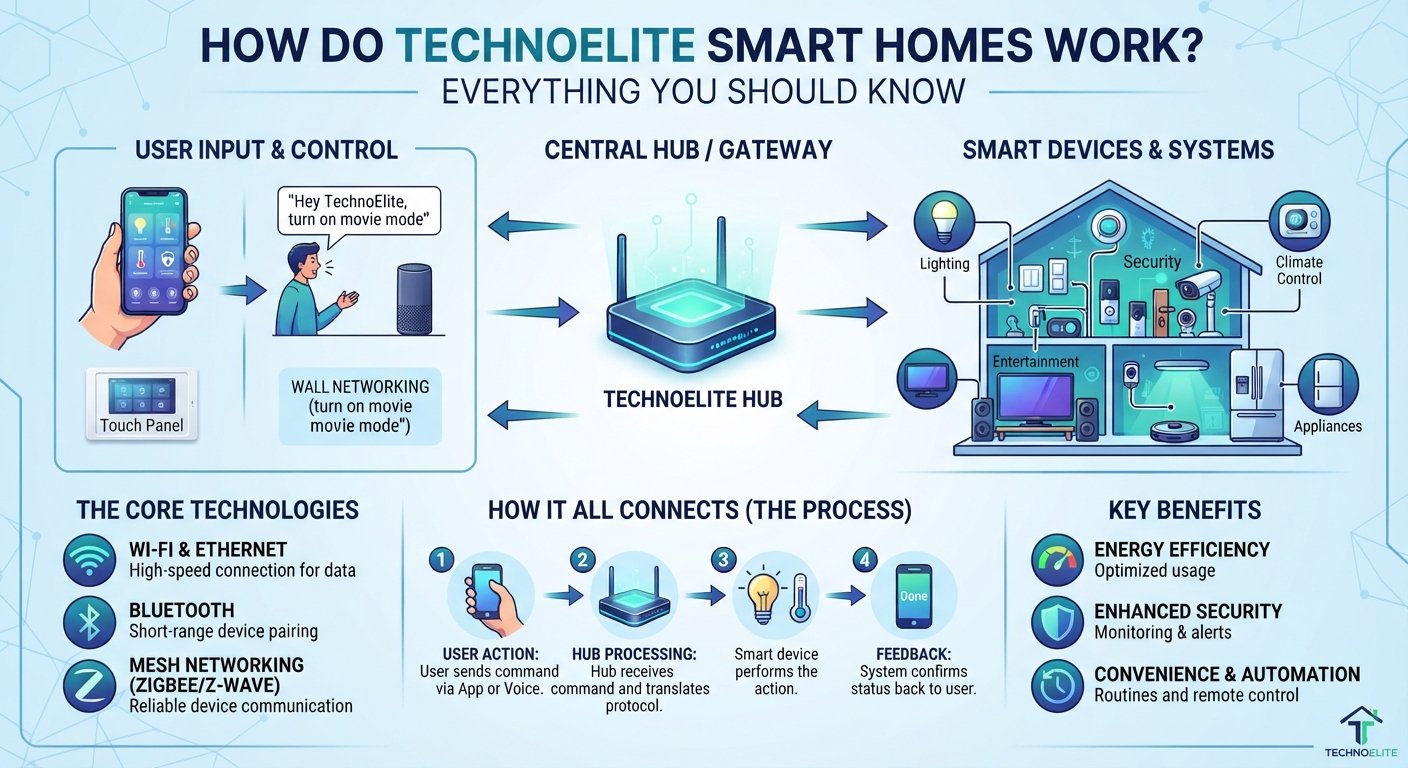
TechoElite smart homes refer to a connected-home approach in which smart devices communicate through supported networks and can be controlled or automated. TechoElite’s current guide explains that connected devices can be used to automate household tasks and identifies connectivity, hubs, sensors, actuators, and user interfaces as important parts of the system.
In general, NIST describes a smart home as a home containing internet-connected devices that can allow homeowners to control physical aspects of the home, such as lighting, thermostats, and security equipment.
Understanding the TechoElite Smart Home Concept
The basic idea is simple: different connected devices work together instead of functioning as completely separate products. A sensor can collect information about the home. A controller or compatible system can process that information according to a programmed rule, and another connected device can respond. For example, an automation could use a sensor event to trigger a compatible light or other device.
How Smart Home Technology Connects Different Devices
Smart-home devices need a communication method to exchange information. The exact technology depends on the products and ecosystem being used. TechoElite’s guide discusses common connectivity options including Wi-Fi, Zigbee, Z-Wave, Bluetooth, and Matter. Compatibility is important because two smart devices are not automatically able to communicate simply because both are described as “smart.”
The Role of Automation in a Smart Home
Automation allows connected devices to perform actions according to predefined conditions, schedules, or routines. Instead of manually turning a light on every evening, for example, a compatible system may be configured to operate TechoElite smart homes according to a schedule. More advanced automations can combine multiple devices and conditions.
How Do TechoElite Smart Homes Work?
The operation of a smart home can be understood as a cycle: a device detects or receives information, the connected system processes TechoElite smart homes, and an appropriate device performs an action.
For example, a sensor may detect movement or another condition. The information can then be communicated through the home’s connected system. If an automation rule matches that condition, a compatible device can respond.
Smart Devices and Connected Systems
Smart devices are the physical products that provide specific functions within a connected home. Depending on the system, these can include lights, thermostats, cameras, locks, plugs, sensors, televisions, and other connected equipment.
NIST has examined several categories of consumer home IoT products, including smart lighting, security cameras, doorbells, plugs, thermostats, and televisions. The important part is not simply having these devices but ensuring that the selected products can communicate and work together in the intended setup.
Sensors, Hubs, and Home Networks
Sensors provide information about conditions around the home. Depending on the device, a sensor can detect events such as movement, temperature changes, or whether a door or window has changed state.
Hubs and controllers can coordinate compatible devices and automation rules. TechoElite identifies hubs or controllers as part of TechoElite smart homes smart-home architecture and notes that some systems can handle certain local automations even when internet connectivity is interrupted.
App and Voice-Based Home Control
Smart-home systems commonly provide user interfaces through mobile applications, control panels, or voice assistants. Depending on the device and platform, a homeowner may use a smartphone to check or control a connected device. Voice interfaces can also provide hands-free control for compatible products.
The FTC notes that internet-connected devices can allow users to perform functions such as changing a thermostat’s temperature from a phone or interacting with devices through voice commands.
What Features Can TechoElite Smart Homes Include?
The exact features of a TechoElite smart home depend on the devices selected and how they are integrated. TechoElite’s current guide discusses connected lighting, climate control, security devices, sensors, locks, cameras, and other smart-home equipment. TechoElite smart homes is therefore better to think of a smart home as a configurable system rather than a fixed list of features that every home must have.
Smart Lighting and Climate Control
Smart lighting can provide digital control and automation through compatible devices. Depending on the system, lights may be controlled through an app, schedule, sensor, or other automation rule. Climate control is another common smart-home application. Smart thermostats can provide programmable temperature control and, depending on the model, remote management and automated adjustments.
Smart Security and Monitoring
Connected security equipment can include cameras, door sensors, smart locks, and other monitoring devices. These products can provide information about activity around a home and may send alerts when configured events occur. TechoElite’s guide includes cameras, locks, and sensors among the components that can be incorporated into a smart-home environment.
Smart Appliances and Entertainment
Connected appliances and entertainment devices can also form part of a smart-home environment. NIST’s consumer IoT research includes products such as televisions among the categories of connected home devices TechoElite smart homes has examined. The main advantage of integration is that compatible devices can potentially be controlled through a common ecosystem or incorporated into appropriate routines.
How Is a TechoElite Smart Home Controlled?
A TechoElite smart homes can be controlled through different interfaces depending on the devices and ecosystem involved. Common options include smartphone applications, voice interfaces, physical controls, and automated schedules. The available controls vary from one product and platform to another.
Using Smartphone and Tablet Apps
Mobile applications can provide a central interface for compatible smart devices. Depending on the system, an app may allow users to adjust a thermostat, control lighting, check a connected camera, manage a lock, or change other supported settings. The FTC confirms that some internet-connected home devices provide remote management through smartphones.
Using Voice Assistants and Voice Commands
Voice control allows users to interact with compatible smart-home devices without manually opening an application. A voice assistant can process supported commands and communicate with compatible devices. However, voice control is not universal, so homeowners should confirm that their chosen devices support the same voice platform.
Creating Automated Schedules and Routines
Schedules and routines are an important part of home automation. A schedule can cause a compatible device to perform an action at a particular time, while a routine can combine several actions or conditions. This can reduce repetitive manual tasks and make connected devices more useful. TechoElite recommends beginning with practical automations and refining the system as homeowners learn how their devices behave in everyday use.
What Are the Benefits of TechoElite Smart Homes?
The potential benefits of TechoElite smart homes come mainly from connecting devices and automating tasks. Depending on the system, smart-home technology can provide convenience, remote access, monitoring, and opportunities for energy management. The actual results depend on the equipment and how it is configured.
Convenience and Remote Access
Smart-home automation can reduce the need to manually operate individual devices. For example, compatible lights or thermostats may be managed through an app or automation rule. Remote access can also allow homeowners to interact with supported devices when they are away from home.
Energy Management and Efficiency
Smart technology can support energy management by allowing compatible equipment to follow schedules or respond to certain conditions. Smart thermostats are one example. The Department of Energy explains that smart thermostats can automate temperature adjustments and provide remote control, although energy results depend on the home, equipment, occupants, climate, and settings.
Home Security and Monitoring
Connected cameras, sensors, locks, and alerts can provide additional information about what is happening around a home. TechoElite’s guide describes smart-home security components such as cameras, locks, and sensors. These technologies can improve visibility and convenience, but their effectiveness depends on proper configuration, reliable connectivity, device security, and appropriate user practices.
How Do TechoElite Smart Homes Handle Security and Privacy?
Security should be considered from the beginning of a smart-home project. Connected devices communicate over networks and may collect, transmit, or process information. NIST research has identified cybersecurity and privacy concerns associated with smart-home technologies and consumer IoT.
Protecting Smart Devices and User Accounts
Strong account protection is an important first step. The FTC recommends changing default usernames and passwords, using two-factor authentication when available, enabling device security features, and keeping hardware and software updated.
Securing the Home Network
Because many connected devices communicate through the home network, router security matters. The FTC recommends changing default router credentials, using wireless encryption, and keeping router software updated.
For larger or more complex installations, network segmentation can also help isolate certain connected devices from other systems. NIST identifies network segmentation as one of the security measures that can reduce risks in connected environments.
Keeping Software and Devices Updated
Software updates can address security problems and improve device reliability. The FTC recommends checking for hardware and software updates for internet-connected devices, while CISA also emphasizes keeping systems and software patched. Before purchasing a smart device, TechoElite smart homes is therefore useful to consider how long the manufacturer is expected to provide software and security support.
What Should You Consider Before Choosing a TechoElite Smart Home?
Building a smart home is easier when the system is planned before devices are purchased. TechoElite recommends identifying household needs, checking compatibility, considering supported protocols, choosing products with appropriate update support, and expanding the system gradually.
Device Compatibility and Connectivity
Compatibility is one of the most important considerations. Different smart-home products may use different communication technologies or platforms. TechoElite discusses Wi-Fi, Zigbee, Z-Wave, Bluetooth, and Matter as examples of technologies used in connected-home environments.
Before buying a device, homeowners should check whether it works with the existing ecosystem and whether it supports the functions they actually need.
Installation and Maintenance
Installation requirements vary considerably between smart devices. Simple products may be designed for consumer installation, while more complex systems involving wiring, networking, or multiple integrated devices may require professional assistance. Maintenance is also part of smart-home ownership. Devices may require firmware updates, account management, network maintenance, and occasional troubleshooting.
Costs and Long-Term Considerations
The cost of a smart home is not limited to the initial purchase price. Homeowners may also need to consider installation, hubs or controllers, compatible accessories, replacement equipment, subscriptions where applicable, and long-term software support. TechoElite recommends considering cost, compatibility, privacy, and update policies before purchasing and expanding the system in stages.
Read more: Coolideas TheHomeTrotters Com: Creative Ideas for Your Home and Lifestyle
Who Can Benefit From TechoElite Smart Home Technology?
Smart-home technology can be useful for different types of homeowners, but the most suitable setup depends on individual needs and priorities.
Homeowners Seeking Greater Convenience
People who want to automate repetitive tasks may benefit from connected lighting, thermostats, locks, and other compatible devices. The benefit comes from reducing unnecessary manual actions and creating routines that fit everyday household activities.
Families Interested in Smart Security
Families may use connected cameras, door sensors, locks, and notifications to gain additional information about activity around the home. These tools can make monitoring more convenient, but users should still pay attention to account security, privacy settings, device updates, and network protection.
Users Looking for Energy Management
Homeowners interested in managing heating, cooling, or lighting can use compatible smart devices to create schedules and automate certain functions. Smart thermostats are one established example of technology that can provide automated temperature control and remote management. However, the actual effect on energy consumption varies from one household to another.
Final Thoughts
TechoElite smart homes are best understood as connected-home environments in which compatible devices communicate and work together to automate or simplify household tasks.
The basic process is straightforward: sensors and devices provide information, networks carry that information, controllers or compatible systems apply rules, and connected devices perform the resulting actions. Apps and voice interfaces can give homeowners additional ways to interact with the system.
The biggest advantages can include convenience, remote access, monitoring, and better control of certain household functions. At the same time, smart-home technology requires careful attention to compatibility, network security, privacy, software updates, and long-term support.
FAQs About TechoElite Smart Homes
How Do TechoElite Smart Homes Work?
TechoElite smart homes use connected devices, sensors, controllers or hubs, communication networks, and user interfaces to manage household functions.
What Devices Can Be Used in a TechoElite Smart Home?
A connected smart home can include devices such as smart lights, thermostats, cameras, sensors, locks, plugs, televisions, and other compatible IoT products.
Can a TechoElite Smart Home Be Controlled Remotely?
Compatible smart-home devices can support remote control through smartphone applications or other connected interfaces. The available functions depend on the individual device, platform, network connection, and configuration.
Are TechoElite Smart Homes Secure?
Smart homes can be protected with appropriate security practices, but connected devices also introduce cybersecurity and privacy considerations.
Can Smart Home Automation Save Energy?
Smart-home automation can support energy management by helping compatible devices follow schedules or respond to certain conditions. Smart thermostats, for example, can automate temperature settings.
